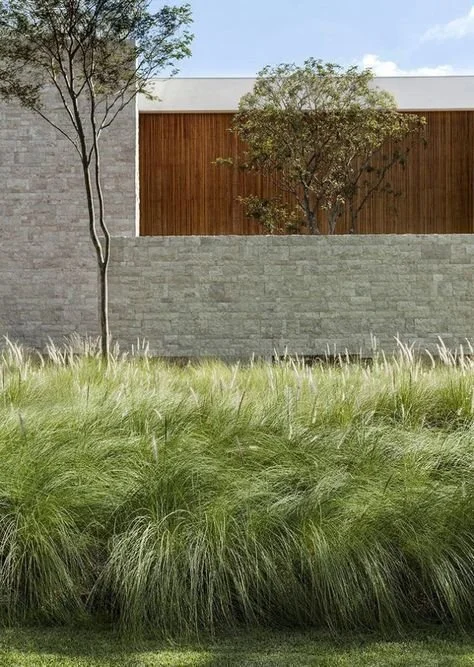
The discipline of restraint
Restraint is not absence.
It is intention refined to its quietest form.
In modern architecture, the building already speaks in full sentences. Clean lines, disciplined geometry, long shadows moving slowly across planes of concrete, steel, and glass. The role of the landscape is not to compete for attention—but to listen.
From a designer’s perspective, plants in modern architecture function less as decoration and more as architectural support. They are chosen not for novelty, but for their ability to reinforce what already exists: line, proportion, rhythm, and scale.
Restraint in plant material is an act of trust. Trust that one species, repeated with conviction, can carry more visual weight than a layered palette ever could. Repetition creates calm. It allows the eye to move horizontally, mirroring the architectural lines of the structure. It creates continuity between built form and ground plane.
Negative space is equally deliberate. Gravel courts, concrete walkways, and open soil planes are not “empty”—they are spatial pauses. These moments of restraint give plants room to be read clearly. A grass clump becomes sculptural. A tree’s branching pattern becomes legible. The architecture remains crisp rather than softened into obscurity.
In modern landscapes, plants are often selected for form, texture, and movement rather than bloom. Grasses bend and respond to wind, introducing time and motion against static materials. Evergreen shrubs provide mass and shadow rather than seasonal spectacle. Trees are chosen for silhouette—how they frame a façade, cast shade, or punctuate an axis—rather than for ornamental flowers.
I often think of planting in these spaces the way one thinks of punctuation in a well-written essay. A pause here. A single emphasis there. Too much punctuation distracts from the sentence itself. Too many plant species dilute the clarity of the design.
Material consistency is just as important as plant restraint. Limiting hardscape materials—steel edging, dark stone, decomposed granite—creates a quiet framework that allows the plant palette to feel intentional rather than busy. Plants then inhabit the space instead of competing with it.
Modern architecture does not ask for abundance.
It asks for clarity.
And clarity requires courage. The courage to stop before the landscape feels “full.” The courage to resist the urge to add one more layer. The courage to let restraint do the emotional work.
When plants are used with discipline, the landscape becomes a mediator—softening the architecture without diluting it, grounding it without overpowering it. It becomes a relationship between structure and soil, permanence and seasonality, stillness and movement.
Restraint is not minimalism for its own sake.
It is reverence.
A recognition that the most powerful landscapes are not those that announce themselves loudly—but those that allow architecture, land, and plant life to exist in quiet alignment.