When landscaping ignores architecture
One of the most common problems I see in Louisville is not poor landscaping — it’s mismatched landscaping.
A home is carefully designed, the masonry is chosen, the windows are proportioned, the entry is emphasized… and then the landscape is treated as a finishing touch instead of a spatial one. Shrubs are placed along the foundation, mulch is added, and the project is considered complete.
But landscaping is not a border.
It is part of the architecture.
Every house communicates how it wants to sit on the land. The materials, rooflines, and symmetry quietly tell you what the surrounding space should feel like. When the landscape doesn’t respond to those cues, the property feels unsettled even if everything is technically “nice.”
This is especially noticeable in newer areas around Louisville, where large homes are often built on open former pasture. The structure is permanent, but the land around it has no hierarchy yet. Lawn fills the space, but lawn alone cannot visually support a large building.
Good landscape design solves that problem by creating layers.
Instead of thinking in plants, start by thinking in zones:
1. The Grounding Zone (near the house)
This area visually anchors the structure to the earth.
The goal is not small shrubs along the foundation. In fact, that often emphasizes the height of the house. What works better are deeper planting areas that project outward from the house — large shrub masses, structural evergreens, or grouped plantings that visually widen the base of the home.
Tip: If your plants sit in a thin 3–4 ft strip directly against the wall, the house will almost always look taller and more exposed.
2. The Approach or Arrival Zone
Your entry should feel intentional. A path, widened landing, flanking plantings, or small trees can create a moment of arrival. Without this, guests walk directly from driveway to door with no transition, which makes the house feel more suburban than residential estate.
Tip: Even a modest home benefits from two repeated elements along the walk — matching trees, hedges, or planting beds create structure and calm.
3. The Middle Layer
This is the most overlooked space in residential landscapes. After the foundation planting, there is often nothing but lawn. This creates a visual gap. The eye moves abruptly from house to open yard.
The middle layer can be planting beds, ornamental grasses, low shrubs, or small trees arranged in groups. Its job is to connect the architecture to the broader property.
Tip: If you stand in the street and see house → grass → property line, you are missing the middle layer.
4. The Outer Edge
Properties feel comfortable when they have a defined boundary, even a soft one. This doesn’t mean a fence. It means trees, understory plantings, or naturalized areas that frame the space and give the home a sense of place.
Tip: A single tree in a corner rarely frames a yard. Groups of trees or layered plantings do.
The most helpful way to understand this is to look at how different architecture asks for different landscapes:
A modern or contemporary home — clean lines, large glass, minimal trim — needs restraint. Fewer species, repeated grasses, structured masses, and negative space allow the architecture to remain the focus. A cottage-style planting full of color would visually compete with it.
A traditional brick colonial — symmetrical windows and centered door — benefits from order. Aligned walkways, balanced plantings, and repeated forms reinforce the structure’s formality. Loose naturalistic planting would feel disconnected from the home’s geometry.
A stone or European-inspired home — heavier materials and steep rooflines — needs grounding and depth. Larger planting areas, layered shrubs, and canopy trees help the home feel settled into the land rather than placed on top of it.
Louisville landscapes often struggle because we install plants before we establish structure. The result is tidy but temporary — a house placed on land instead of a home settled into it.
At Blend Design, we start by reading the architecture and shaping space first. Plants are chosen after the layout is resolved. When the zones are correct, fewer plants are actually needed, and the property feels calmer, larger, and more intentional.
The goal of landscape design is not to fill a yard.
It is to create a relationship between the house and the land so the property feels complete — not newly planted, but established.
When that happens, people rarely comment on specific plants.
They simply say the home feels right.
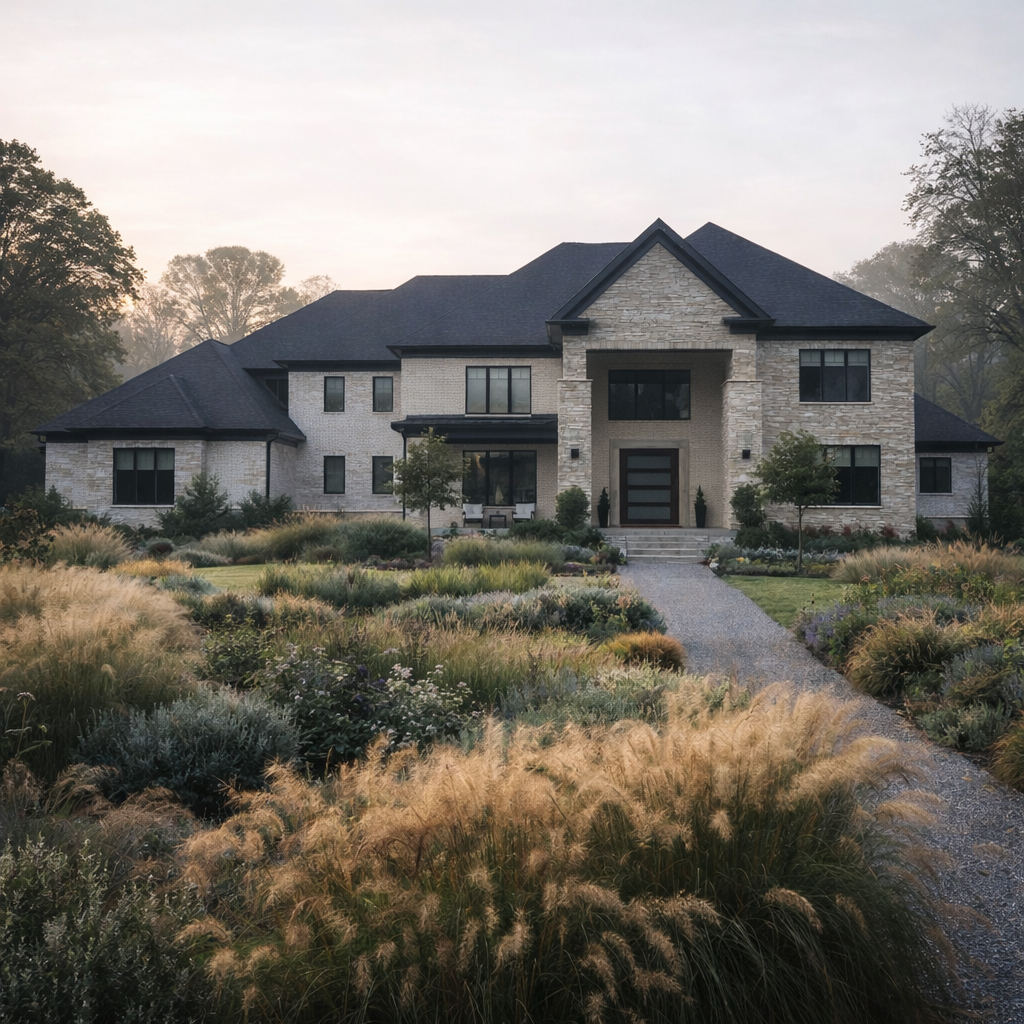
A house feels calm when it belongs to its surroundings.